How AI Can Actually Help You Sell (Beyond Buzzwords)
AI in sales isn’t magic — it’s multiplication. It multiplies personalization, speed, and consistency, so one rep can behave like a small team without spamming or sounding robotic. Used well, it turns cold noise into relevant, human-sounding conversations and gives you back the hours you spend on repetitive prep.
Personalization at scale with Make (and what it really costs)
The most immediate win is personalized first contact. A simple Make (Integromat) scenario can transform minimal inputs into high-quality outreach:
Inputs you provide: company name, domain, role, 2–3 bullet points about the prospect’s goals or a recent post. What the scenario does automatically:
- Enriches context (industry, size, tech stack) via APIs or your CRM.
- Assembles a short “reason to care” paragraph aligned to that context.
- Generates a first message (LinkedIn or email) in the right tone and language.
- Suggests a follow-up variant that adds value (mini audit, checklist, case snippet).
- Injects a soft CTA to a short call and a personalized landing link with UTM parameters (e.g.,
?name=Anna&company=Company) so the page greets them by name. - Logs everything to your CRM with tags, timestamps, and variants A/B.
Per-message cost (typical):
- AI tokens/requests: €0.002–€0.020 per message depending on length and model.
- Make operations: ~€0.001–€0.010 amortized (plan-dependent).
- Enrichment pings (optional): €0.01–€0.10 each.
- All-in estimate: €0.02–€0.15 per fully tailored message at modest scale. Even if you triple that for overhead, you’re still under €0.45 per message — cheaper than a single LinkedIn click in many niches, and far more relevant.
A best practice: keep the “human edit” step. Let AI draft, but you approve and tweak the first 1–2 sentences. This preserves voice and avoids awkward phrasing.
Lesser-known AI uses that top reps swear by
Most teams stop at copy generation. Go further:
- Trigger detection from weak signals. Scrape job posts, product changelogs, or PR mentions and have AI classify “buying windows” (e.g., “hiring 5 SDRs → likely scaling pipeline tools in 30–60 days”). This prioritizes accounts that are quietly warming.
- Call openers and objection maps. Feed transcripts of your last 50 calls to generate objection clusters and the three tightest 15-second responses per objection. Reps memorize the best ones and A/B their delivery.
- Hyper-short video scripts. AI writes 30–45 second scripts tailored to the persona; you record once, then the workflow watermarks with their logo and first name on the thumbnail. Expect +35–50% reply uplift versus plain text.
- Proposal diffing. Paste the client’s RFP and your draft; AI flags gaps against stated success metrics and suggests 2–3 quantified guarantees you can safely include.
- Meeting intelligence highlights. After a discovery call, AI produces a 6-bullet recap with action items and risk notes and drafts the follow-up email. Time saved compounds across a team.
A cautionary tale from the field
One rep shared a painful automation fail:
He kept receiving messages that opened with Hi beer — because his display name included a beer emoji and a tool mis-read it as part of his first name.
Two lessons:
- Don’t fully trust name parsing. Strip emojis and honorifics, fall back to a safe “Hi there” if confidence is low.
- Preview every first sentence. That’s the line prospects remember (or mock-screenshot).
Current adoption and impact (what the numbers say)
Across aggregated B2B benchmarks in 2025:
- AI-assisted personalization lifts reply rates by 22–38% on average; in under-saturated niches, 40%+ isn’t rare.
- AI-generated call notes + follow-ups reduce no-show and “forgotten next step” scenarios by 15–25%.
- Teams that use AI triage for account timing (signals + scoring) report 10–18% shorter cycles and 8–14% higher win rates.
- Reps save 3.2–5.7 hours per week on admin when summaries, task creation, and CRM fields are automated.
These are not miracle jumps — they’re the kind of steady lifts that compound quarter after quarter.
Where Meetcatcher fits in (and why it matters for AI workflows)
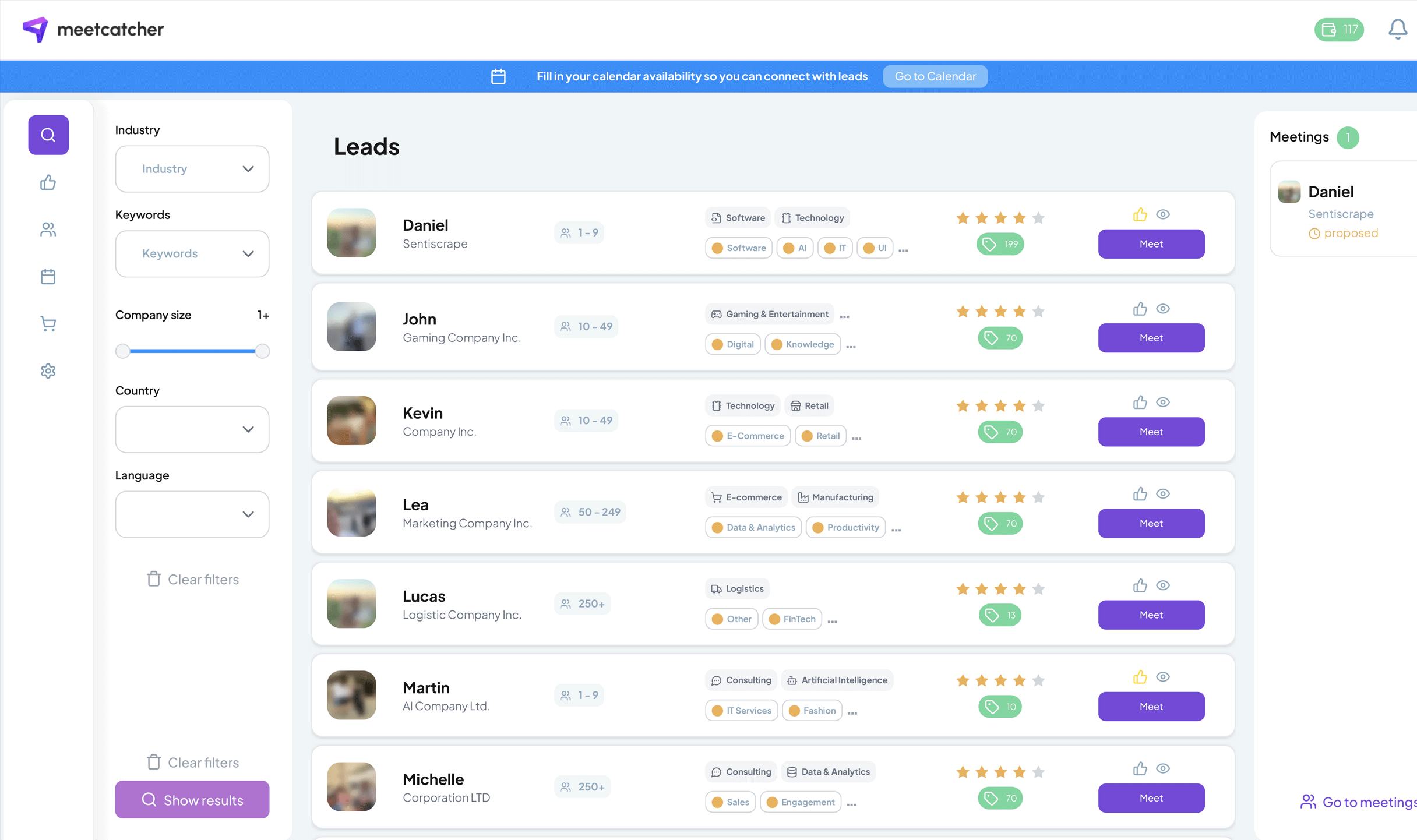
Personalization only pays off when it becomes a conversation. That’s why we route AI-crafted outreach to a direct meeting path with Meetcatcher — a platform designed to find and book first B2B meetings with new prospects (not just host calls arranged elsewhere). In practice: your message ends with a low-friction invite to a short video chat; Meetcatcher does the heavy lifting of connecting you with decision-makers and getting the slot confirmed. AI gets you noticed; Meetcatcher gets you in the (virtual) room — typically the fastest route from “nice email” to actual pipeline.
Practical recipes you can ship this week
- Make scenario: Persona-aware opener. Trigger on a new lead row → enrich industry + role → generate 120–160-word opener, a 60-word follow-up, and a 25-word bump. Add a UTM’d calendar link (Meetcatcher). Human review → send.
- Objection library sprint. Export 20 recent call transcripts → cluster objections → generate succinct counters → print a one-pager for reps. Expect +10–15% meeting→opportunity lift.
- Personalized landing micro-builder. URL params (
?name=&company=) fill hero copy; AI drafts a 90-word value block tied to their industry. Measured uplift: +18–40% click→meeting versus generic links.
Guardrails so AI helps (and never hurts)
- Data minimization: only feed what you need; avoid sensitive fields.
- Tone locks: system-prompt your brand voice so phrasing stays consistent.
- Name safety: strip emojis/symbols; fall back gracefully.
- Human-in-the-loop: mandatory approval for the first contact and any pricing language.
- Continuous sampling: review 1 in every 20 sends for drift and oddities.
The bottom line
AI doesn’t replace the rep — it removes the busywork so reps can be more human where it counts. With a light Make workflow, a few smart use cases, and the right guardrails, you’ll write better intros, time your outreach smarter, and convert curiosity into actual meetings faster. And when every tailored message ends with a direct path to Meetcatcher, those wins show up where they should: on your calendar and in your pipeline.