How TimTodo Helps Sales Teams Stay Organized and Profitable
When people hear about TimTodo, they often think of it as a tool for freelancers, agencies, or startups working on hourly projects. But that’s only part of the story. In reality, it’s also a powerful system for sales teams who want to stay on top of their deals, meetings, and profitability — without drowning in spreadsheets.
Organization that drives results
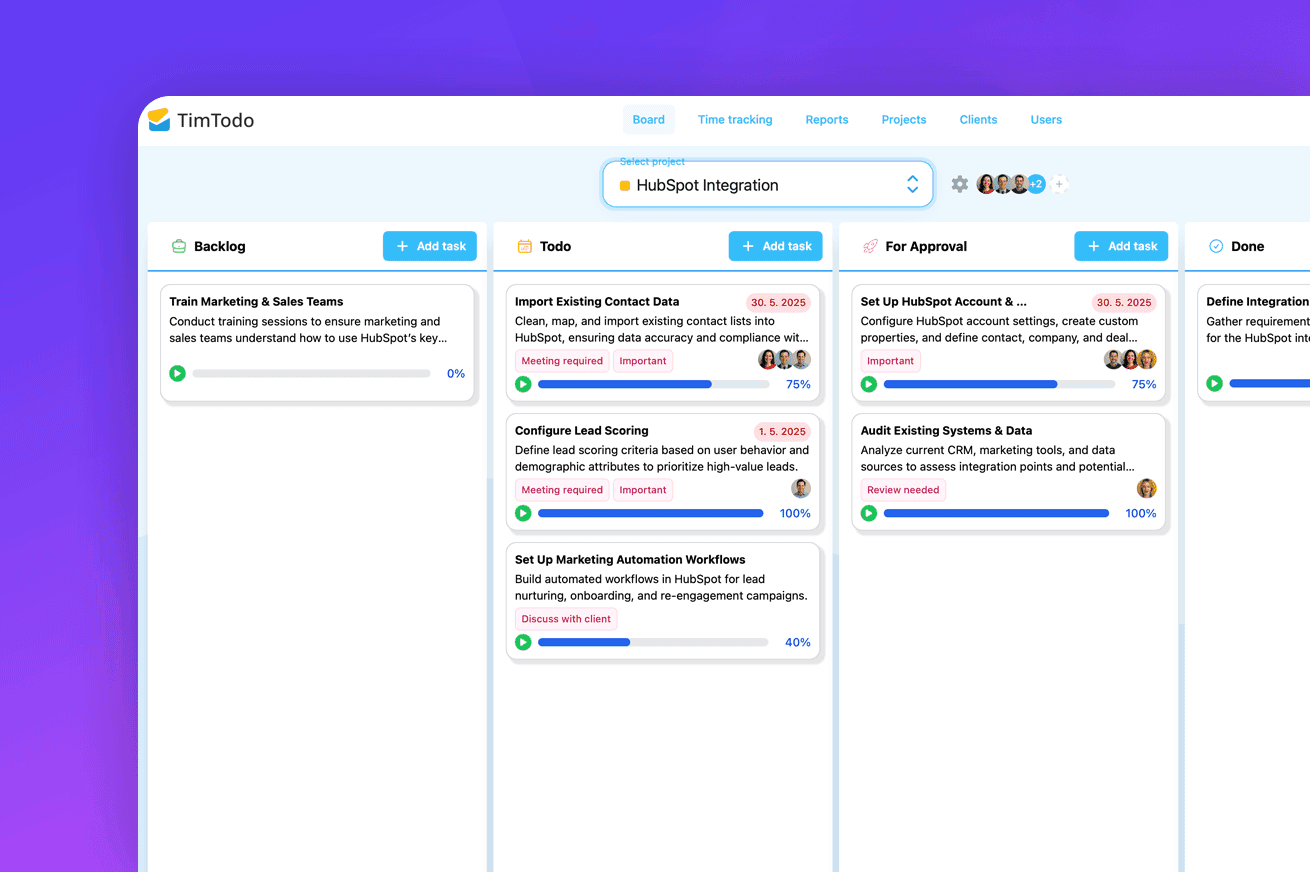
Sales teams live in chaos: follow-ups, client calls, proposals, CRM updates, reporting — and half the day disappears in context switching. TimTodo helps tame that chaos through its Board view, where every task can be clearly assigned, prioritized, and tracked.
Each board represents a client or a sales stage, and every task is time-tracked in real time. You can see exactly how much effort each opportunity takes — not just in theory, but in hours.
That matters because sales isn’t just about closing deals; it’s about understanding what those deals cost. If one type of client takes 20 hours to convert and another only 5, that’s insight your strategy can be built on.
Tracking effort and true cost
Inside TimTodo, every task can be linked to a specific project or lead. That means you can measure:
- How many hours each salesperson spends on prospecting, follow-up, or onboarding.
- Which leads consume the most time before closing.
- The real cost per client acquisition — calculated from hourly rates and time logs.
This level of transparency helps teams make smarter decisions: who to prioritize, where to improve efficiency, and which opportunities might not be worth the chase.
One head of sales summed it up perfectly:
Before TimTodo, we knew who closed the deal. Now we know how much each deal cost us in time. It completely changed the way we plan and forecast.
That’s the kind of clarity most CRMs don’t provide — because they track outcomes, not effort.
Built for teams that change
Sales departments evolve fast. Team members join, leave, or rotate roles every few months. That’s why the fact that TimTodo can be free for unlimited users is a serious advantage.
In tools that charge per seat, scaling the sales force — even temporarily — becomes expensive. Here, you can onboard as many people as needed without extra cost, making it ideal for dynamic sales environments and growing startups.
Cost efficiency without compromise
Unlike heavy enterprise systems, TimTodo isn’t designed to overwhelm you with features you’ll never use. It’s lightweight, intuitive, and — crucially — affordable. In many cases, small sales teams can run entirely on the free version, using boards, time tracking, and reporting without hitting paywalls.
The result is a clean, transparent overview of your team’s daily reality — what they’re doing, how long it takes, and what it’s worth.
More than a project tool — a profit tool
With time-tracking and cost attribution built in, TimTodo effectively turns every sales project into a mini P&L statement. You don’t just track progress — you see profitability.
For sales managers, this means better forecasting and smarter allocation of human resources. For salespeople, it means less guesswork and more control. And for founders, it means finally having the data to see which deals are truly moving the company forward.
Final thought
Sales is a process of constant iteration — finding what works, repeating it, and cutting what doesn’t. TimTodo gives you the visibility to do that intelligently, every day.
Whether you’re running a startup, an agency, or a full sales department, it’s one of those rare tools that grows with you instead of getting in your way — and that’s why more and more sales teams rely on it to stay organized and efficient.