MQL vs SQL: The Real Difference That Shapes Your Sales Funnel
If your sales and marketing teams argue about lead quality, you probably lack one key distinction — the line between MQLs and SQLs. Both are “leads,” but they live in different stages of the buyer journey, and the success of your funnel depends on how well you can tell them apart.
MQL vs SQL — the fundamental difference
- MQL (Marketing Qualified Lead): a person or company that has shown interest but hasn’t yet had a conversation with sales. They might have downloaded a guide, subscribed to your newsletter, or interacted with your campaign.
- SQL (Sales Qualified Lead): a lead that sales has vetted as ready for direct contact or proposal. They fit the target profile, have clear intent, and can make or influence the buying decision.
Think of it as the difference between interest and intent. An MQL raises a hand; an SQL opens the wallet.
Different metrics, different goals
MQL and SQL have different success criteria — and confusing them often leads to internal friction.
- For MQLs, the key metric is usually the meeting rate: how many marketing leads convert into real conversations.
- For SQLs, the success metric shifts to close rate: how many of those conversations turn into customers.
That’s why marketing should be judged by lead generation and qualification efficiency, while sales should be judged by conversion and revenue.
As one B2B sales consultant put it, “Marketing’s job is to fill the calendar, not the invoice. Sales turns meetings into money.”
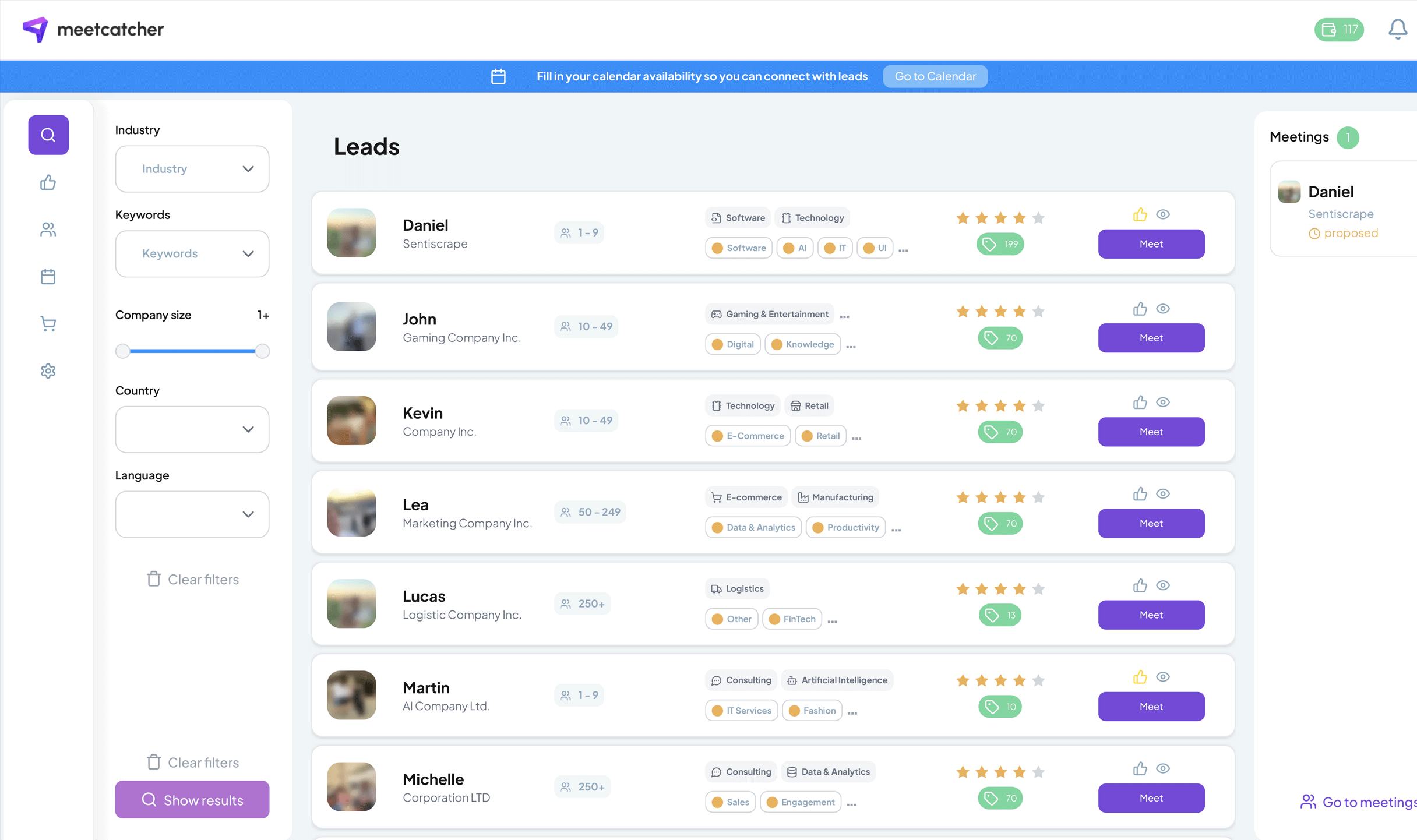
When you align both sides with clear metrics, you stop arguing about “lead quality” and start improving the whole funnel together. You can also use services (like Meetcatcher) to find B2B leads and organize meetings.
Industry benchmarks
Across 2025 B2B benchmarks, the average conversion rates look roughly like this:
- Visitor → MQL: 2–5%
- MQL → SQL: 25–45%
- SQL → Customer: 10–30%
These are mid-range numbers. In mature SaaS or agency businesses with well-defined ICPs, MQL→SQL conversion can exceed 50%, while in early-stage or broad targeting campaigns it often sits closer to 20%. Meanwhile, enterprise B2B companies, where cycles are long and deals complex, might see SQL→Customer as low as 8–12% — still perfectly normal due to the size of contracts.
The lesson: you can’t benchmark your funnel without considering deal value and sales cycle length.
Using MQL and SQL for performance evaluation
Once you define these two lead types, you can build a simple yet powerful evaluation model:
- Marketing’s performance: measured by the volume and cost of MQLs, and how many progress to SQLs.
- Sales’ performance: measured by the conversion of SQLs into paying clients and revenue per SQL.
- Overall team alignment: measured by the MQL→SQL→Customer flow efficiency. If marketing produces many MQLs but few convert to SQLs, your targeting or lead scoring needs refinement.
Tracking both levels also reveals where to invest. If your MQL→SQL rate is low, fix messaging and segmentation. If SQL→Customer is low, review objection handling, offer design, or sales timing.
A high-performing sales director once summarized it perfectly:
Marketing fills the top of the funnel; sales expands it from the middle down. You can’t optimize one without measuring the other.
Where MQL/SQL models make sense — and where they don’t
This two-stage model shines in businesses with structured buyer journeys and multi-touch marketing, such as:
- SaaS products and subscription platforms
- Agencies and consulting firms with inbound or outbound funnels
- B2B marketplaces and service providers
However, in transactional or referral-based B2B, the distinction blurs. For example, a small web studio that gets clients directly through referrals doesn’t need MQL scoring — their funnel is too short. Likewise, companies relying solely on account-based selling (ABS) often skip MQLs entirely and move straight to SQL-level tracking.
The bridge between teams
The true value of the MQL/SQL system isn’t the labels — it’s the collaboration it forces. It creates a shared language between marketing and sales. When everyone agrees on what “qualified” means, campaigns become smarter, feedback loops faster, and resources better spent.
In well-aligned organizations:
- Marketing doesn’t complain that sales “doesn’t follow up.”
- Sales doesn’t claim that leads are “junk.”
- Everyone knows their number, and they all track it against the same benchmarks.
That alignment alone can raise overall conversion rates by 15–25% across the pipeline.
Final thought
MQLs and SQLs aren’t buzzwords — they’re coordination tools. Defining them clearly transforms vague marketing data into actionable sales insight. And while the exact ratios vary by industry, the principle holds: measure interest and intent separately, reward both teams for what they control, and never forget that a qualified lead only matters when it becomes a customer.