What Are Typical SaaS Conversion Rates? Benchmarks, Math, and Realistic Paths to Paid
A “good” SaaS conversion rate depends on channel mix, intent, friction in your onboarding, and how quickly you get prospects into real conversations. The point isn’t to chase a magical industry average, but to understand your funnel math and decide where 0.3–0.7 percentage points can realistically be gained in the next two weeks.

Calling after three days: real-world meeting rates
A seasoned B2B rep shared this practice: they call new connections three days after a LinkedIn connect. From 100 dialed numbers they usually book:
- 3–4 meetings for larger/complex IT systems (longer cycles, more stakeholders).
- 6–7 meetings for smaller IT/SaaS tools (clearer value props, fewer blockers).
- ~17 meetings when the offer is truly unique (e.g., servers, IT security niches).
These numbers look modest on paper, yet they stack fast. If your first-meeting→paid conversion is only 12–25%, even the “3–4 per 100” bucket creates early pilots when repeated weekly with discipline.
A conservative SaaS funnel: registration → trial → paid
Let’s model a basic funnel with pessimistic but realistic ratios. The product requires registration, begins a trial, then offers a paid plan. We’ll compare PPC vs email and then see what remarketing does to the same math. To keep things apples-to-apples, we’ll express each step with decimal proportions and describe the counts textově (bez tabulek).
PPC (1,000 ad clicks; CPC = €2.50)
- Visit → Registration: 0.035 (3.5%). Out of 1,000 visitors, about 35 register.
- Registration → Trial started: 0.70. Roughly 24.5 start a trial.
- Trial → Paid: 0.22. That yields 5.39 paid users.
End-to-end conversion: 5.39 / 1,000 = 0.00539 (≈ 0.54%). Media cost: €2.50 × 1,000 = €2,500. Blended CAC (media only): €2,500 / 5.39 ≈ €464 per paid user.
Where PPC often hurts is variance: wrong keywords or a leaky page can easily push the final rate under 0.004 and CAC above €600. Conversely, strong intent and crisp “reason to try now” can lift this to 0.008–0.010.
Email outreach (1,000 targeted contacts)
Assume verified data plus a short, helpful message sequence:
- Open rate: 0.45 → 450 opens.
- Click-through: 0.08 → 36 visits.
- Visit → Registration: 0.25 → 9 registrations.
- Registration → Trial started: 0.80 → 7.2 trials.
- Trial → Paid: 0.30 → 2.16 paid users.
End-to-end conversion: 2.16 / 1,000 = 0.00216 (≈ 0.22%). Direct media cost is low; the true cost is time, tooling, and domain warm-up. For well-defined ICPs, this channel scales steadily with quality lists and weekly rewriting.
What happens if you add remarketing?
A lightweight retargeting layer (e.g., €200/month focused on visitors and trial drop-offs) typically improves return visits and intent recall. In pessimistic mode:
- Registration rate nudges from 0.035 → 0.041 (+17%).
- Registration → Trial goes 0.70 → 0.75 (+7%).
- Trial → Paid rises 0.22 → 0.27 (+23%).
Back to the PPC example: 1,000 clicks × 0.041 = 41 registrations → 30.75 trials → 8.30 paid.
End-to-end conversion: 8.30 / 1,000 = 0.00830 (≈ 0.83%). Blended CAC (media only): €2,500 / 8.30 ≈ €301. Even tiny bumps at each stage result in a ~35% CAC reduction.
Quick takeaway: if you can lift landing registration by +0.006 (from 0.035 to 0.041) and trial→paid by +0.05 (from 0.22 to 0.27), you meaningfully change the business.
LinkedIn outreach: human-first conversion paths
LinkedIn sits between email and PPC: lower raw scale, but higher per-contact intent when you mix content and DMs.
- Connection acceptance: 0.40–0.60 if your profile looks credible and you’re niche-relevant.
- Replies per outreach: 0.15–0.25 when you don’t pitch immediately and reference a problem the prospect actually has.
- Meetings booked: 0.06–0.10 of total outreaches (often 0.25–0.30 of replies).
- First-meeting → Paid: 0.015–0.03 of total outreaches across a 30–45 day window, higher if you sell a sharp wedge use case.
“When I stopped pitching and started asking, ‘Would it make sense to compare notes on how you handle X?’, my booking rate tripled,” one rep told me. The key was short messages, visible proof of work, and a clear next step.
Where tiny improvements move the needle the most
If you must choose one lever per stage under a “worst reasonable case” scenario, pick these:
- Visit → Registration: cut fields to email + role; add “try-without-card” and a 90-second product video. A realistic lift is +0.004–0.010 absolute.
- Registration → Trial: trigger “get started” with a one-click template or demo dataset. Expect +0.05–0.15 absolute.
- Trial → Paid: align aha-moment within 30–90 seconds; send a value-based “day 2” email; offer a quick 10-minute audit call. Expect +0.03–0.08 absolute.
And always instrument behavior. Tools like Hotjar or Cavity expose rage-clicks, mobile traps, and the exact fields causing drop-off. Fixing just one killer friction can outperform a month of extra traffic.
Meetings as the shortest path in B2B
B2B buying is multi-threaded: you’re not just converting a user, but an organization. That’s why “great benchmarks” on paper still feel slow in real life—there are approvals, timing, and reputational risk for each stakeholder.
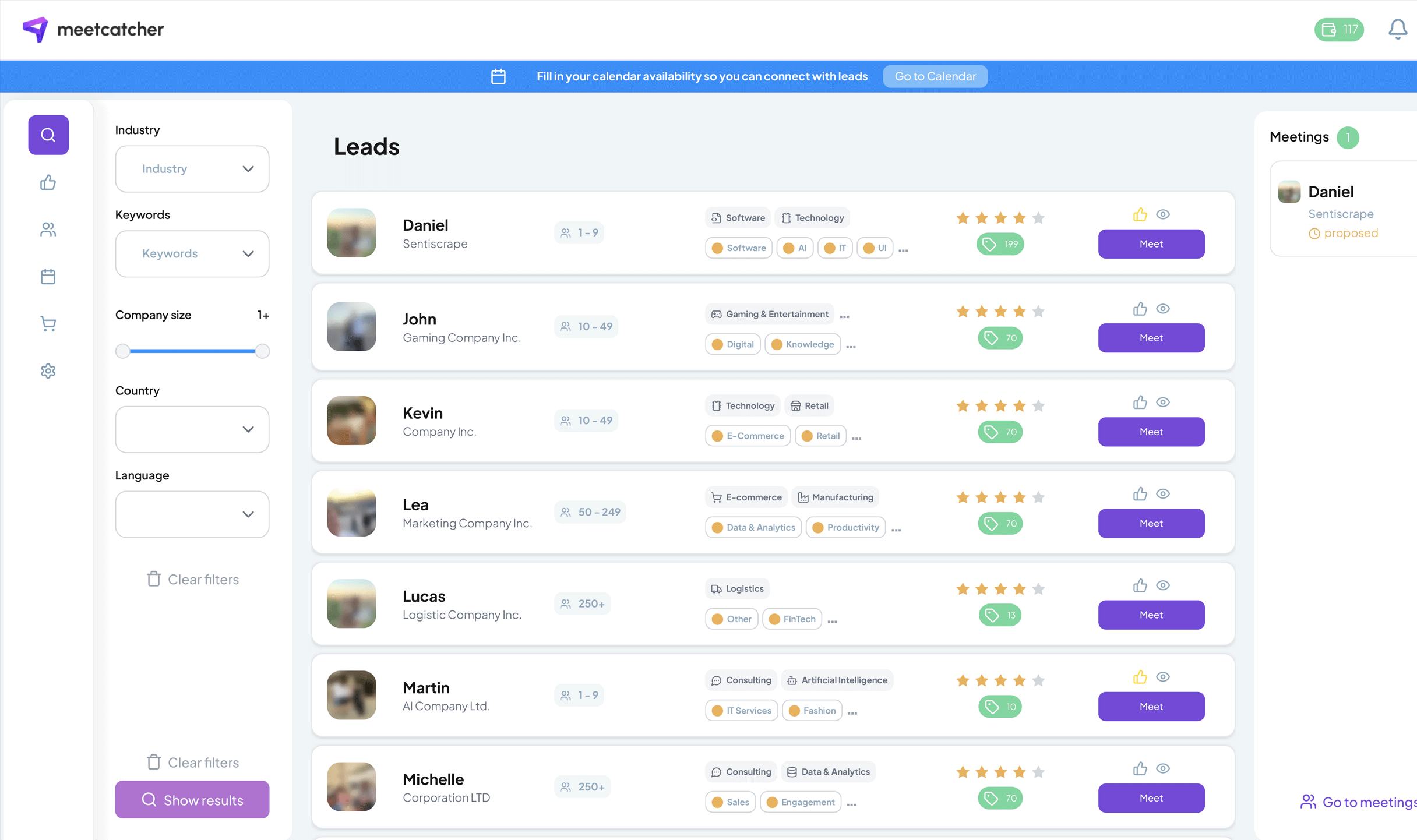
Instead of waiting for trials to self-qualify, many teams pull conversations forward. If your goal is to book short qualification video calls without calendar ping-pong, consider using a tool designed for quick B2B intros. With Meetcatcher, you can invite targeted prospects, offer tight time slots, and use a credits-based system that nudges people to actually show up. In other words: you skip weeks of back-and-forth and move straight to “Does this solve your problem today?”
Final thought
Judge your funnel by repeatable paths to paid, not by one-size-fits-all averages. If your current PPC end-to-end rate is 0.005, aim for 0.007–0.009 with messaging, remarketing, and a sharper “why now.” If LinkedIn replies sit at 0.12, try pre-qualifying in comments and sending half as many but twice as relevant DMs. If email is at 0.002, tighten your ICP and rewrite every week. The compounding effect of modest gains at each step is how SaaS funnels go from “nothing moves” to “this is working.”```